
Photosynthetic people
Tuesday, 12 August, 2008I was reading a recent article – “Changing the nature of human beings” – by Julian Savulescu in the Sydney Morning Herald, and he mentions this:
So one day we could have people with sonar like bats, or people with the ability to create their own energy by photo-synthesising sunlight like plants.
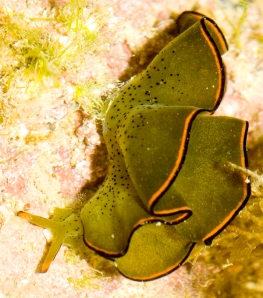
Elysia ornata
At first I was dismissive of the idea of solar-powered people, but then I remembered reading in a marine biology pamphlet that certain sea slugs are ‘solar-powered‘. I investigated that some more, and it does turn out that certain molluscs have a symbiotic relationship with chloroplasts that they steal from the algae they eat, which – like plants -are organisms that normally utilise chlorplasts. (Rumpho et al, 2000). One molluscan slug species, Elysia chlorotica, can survive for up to nine months without eating: just on light and carbon dioxide (Green et al, 2000), and even then the slugs die of old age not hunger. Still, the chloroplasts die after about six to ten months, and need to be replenished by eating more algae.
Chloroplasts are solar-power plants of the plant cell, just like the mitochondria that animals and fungi rely on (plants have mitochondria too though). Just as mitochondria were once proteobacteria, plastids (of which chloroplasts are the most noteworthy) were once cyanobacteria, and both still have their own DNA and a very bacteria-like membrane. They have evolved to get very comfortable with the relationship, offloading much of their essential genes to the host nucleus, and now they can’t live without their hosts (then again, we can’t live without our endosymbionts).
This means, however, that if we humans wanted chloroplasts for ourselves, or our livestock or pets, we would need to genetically modify the host animal to express proteins required for chloroplast function. It has been estimated that about 70-90% of the genes required for chloroplast function are provided by the plant’s genome (Martin et al, 1998). In the case of the sea slugs, some of these genes appear to exist in the animal’s genome, although probably not enough for the chloroplasts to be able to reproduce. Which is why the slugs use kleptoplasty – removing the chloroplasts from their food.
It would probably be most feasible for chloroplasts, along with the required genes, to be added to skin stem cells and applied as a skin graft, as there is a lot of research in this area for burns victims. This approach has been used to produce proteins in mice (Larcher et al, 2001), and so should be feasible for producing sugar by photosynthesis in humans. At first this graft may require regular replacement, but eventually the chloroplasts will be sustainable within the skin.
There are a few problems (the 5th problem is, in my mind, the biggest too).
1. The immune system may attack the chloroplasts, but maybe they will be safe from antibodies if they are inside the cell (the immune system will attack mitochondria, but only if they are present in the blood).
2. The photosynthesising skin would necessarily be green as that is the colour of chlorophyll. I suppose the melanocytes of human skin could be engineered to produce another pigment, causing the skin to take on a different colour, but then again it might not be such a big problem to be green skinned…unless you are sensitive to Bruce Banner jokes.
3. People may get sunburn and skin cancer when they are out ‘feeding’ on sunlight, as while the red and blue parts of light will be used, the ultraviolet component of sunlight causes damage to living cells. To absorb this before it causes damage, vertebrates have melanins (and humans augment this with sunscreen), and plants/algae (which don’t use UV light) produce screening compounds. It is likely that a derivable sunscreen pigment, which does not darken the skin like melanin, could be produced by melanocytes and absorb the UV-B light. But the idea of endogenous sunscreen is beside the point of this post (to be dealt with another time).
4. The reaction of photosynthesis can be simplified as the following:
6 CO2(g) + 12 H2O(l) + light → C6H12O6(aq) + 6 O2(g) + 6 H2O(l)
It is now obvious why plants need to be watered – there is a net loss of six water molecules for every glucose molecule produced. This would mean that the plant-person (or algae-person) would also need a lot more water than a normal human, which would be a disadvantage in a desert environment.
5. It wouldn’t produce much energy for an active organism like a human. The average human being has 1.8m2 of skin, approximately half of which would be exposed to the sun (if naked and lying as you would if tanning). The Earth is bathed in much energy from the sun, but of that solar radiation only the wavelengths from 400-700nm are usable by plants (termed photosynthetically active radiation, or PAR). Even at midday on a very sunny day, the PAR energy flux density (or, the amount of plant-usable light energy per unit area of ground per second) is only 400W/m2 (Warrington, 1978). Photosynthetic efficiency (amount of light energy converted into usable chemical potential energy) typically is about 3-6%, so let’s assume 5. So the energy produced by a human being lying in the sun for an hour (3600 seconds) at midday would be:
400 J/s/m2 x (0.5 x 1.8m2) x 0.05 x 3600s = 64800J = 64.8kJ (or 15.43 kcal)
By comparison, an apple has about 400kJ of usable food energy. So an hour in the sun is about the same as a sixth of an apple. The daily energy requirements for a human being sit around 10,000 kJ per day, so that’s going to require 150 hours per day of sitting in the sun. Needless to say, that’s impossible.
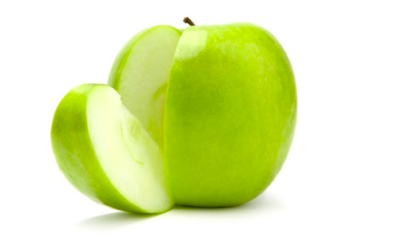
This apple can give you as much energy as an entire day's worth of photosynthesis.
So, although photosynthetic humans would need less food, it wouldn’t be substantially less. Still, over a large population, it could slightly reduce the need for farmland. In addition, as I alluded to earlier, this could be done to livestock too, and with a large number of livestock that could noticeably reduce the area of land required to feed cattle or horses (hairy animals like sheep or sensitive-skinned animals like pigs may be more difficult, as the hair would reduce the light available for photosynthesis).
So, solar-powered photosynthetic people are possible, but it wouldn’t significantly alleviate food requirements…but it might make a little bit of a difference, until the sun burns out or is clouded out by pollution or something.
Image credit:
The image, of the sea slug, is of the sacoglossan slug Elysia ornata. It was taken by Flickr user budak, and released under Creative Commons BY-NC-SA license.
 Human Enhancement and Biopolitics
I love the internet. It never fails to assure me that I am NOT crazy when I think of these things. I wish very much that this could happen. Some people think modifying humans is ridiculous and should be immediately stomped on, but let’s look around us…
Change and destruction is consuming us. We need to take control and use the knowledge that we have confidence in. Restoring wild land, putting an end to world hunger, sucking up excess carbon dioxide, and sporting green skin? Photosynthetic people will be the Martians who have ascended to save the planet. Hell, I’d be the first in line.
I agree the internet is an amazing thing. I just looked this up on youtube and found no results but this article is great. I’m very happy this world has scientists to think of things like this. I randomly thought hmmmm if solar panels can create energy then why can’t humans harness the glucose molecules from photosynthesis?
I have a project to design a Photosynthetic Human, so I googled this and this article completely explained the concept of this idea. Great Article. Go Internet!
[…] to digest your pacemaker or cyborg implants (at least, not usually). It may even be possible to add organelles responsible for photosynthetic anabolism, allowing for sunlight, carbon dioxide and water to be used as raw materials for the human […]
I’ve been searching for something like this for a while and I’ve finally found it. Very fascinating indeed.
It would seem to me that photosynthesis humans already exist, they are the dark pigmented persons of our human species, persons whose skin color is brown to black in color. Their their greater abundance of melanocyte cells than are present in the skin of Europeans produces the skin color due to absorption of the Sun’s light as plants do, but their light absorption is evidenced by brown to black color instead of green. Humans evidencing this stronger pigmentation require oxygen and ingestion of animal proteins and all the other foods in order to live just as do White persons, but their bodies also perform photosynthesis as an additional source of energy.
Perhaps, this is another reason that Africans in Africa, although living greatly in starvation continue to survive and even why the African slaves in this country who were fed on trash food like hogs, hence malnourished and worked like mules under extreme inhuman conditions including the burning Sun of the the South still very well survived; these same conditions of slavery when initially tried on the native American Indian were unsuccessful, it killed the Indians.
Scientists say Black/Brown humans also have a Pineal gland in their brain that aids in this photosynthesis process along with their melanocyte cells and also helps them produce at night the age retardant melatonin nutrient that is so extremely helpful to body repair and rejuvenation. In the European scientist research has discovered this gland has mostly calcified and thus does not operate. And this calcification occurred during evolution thousands of years ago when the Black African traveled out of Africa by the natural land bridges then in existence, to the European contient and caught in their more prolonged Ice Age the system of photsynthesis ended along with calcification of the Pineal gland and this is why the European lacks skin color.
I would love anyone else comments on my thoughts.
Are you mentally insane? Honestly? You truly believe that black people can photosynthesize? Do you have any idea about a this nifty thing called DNA? I don’t even know where to begin trying to correct the immense amount of garbage that just spewed out of your mouth…..
suzy your on to something! tom, it would seem that you’ve assumed to much about whats possible based on western understanding of medicine. the same medicine that cant cure a common cold after 300 yrs of practice… im a brown skinned man who is on a african biomineral diet and in this diet we do not consume meat or starch, just minerals that are plant based. we also do ALOT of sun bathing and being that i drink my food and only have to do it twice a day i would say that sun eating for the humans with a stronger focus of carbon which is what western medicine likes to call melanin is very possible and being done all around the world by atleast a few thousand africans on the bio mineral diet. you should spend more time exploring the sciences of the world which are just different languages in essence and less time assuming with therories of melanin and dna ect because these are theories of possiblilites that no scientist can show you! what is a dna? what is melanin? ask a scientist to show you these things and they’ll give you a microscope showing you a vibration or a equation which are both just languages…..sun eating and mineral consumption-I live this way so this is not a theory that im giving to you, i know its possible! its not easy…but its possible! makes you wonder if a tree that absorbs only three colors of the spectrum can live for thousands of yrs, what can a man who has the ability to absorb way more colors of the spectrum do! perhaps the stories of people living for hundreds or thousands of yrs isn’t as crazy as we like to think. we should keep a open mind
Thank you! What an idiot!
Just saying… ever seen a White person as better athlete when given the opportunity to compete? Just observing how it is, what it is. Just because you don’t believe it, don’t mean it is not true. Perhaps it’s better to think that White people are not good athletes without injecting steroids. Yes?
The only reason that individuals with dark skin have dark skin is to reduce sunburn. Individuals with light skin are mutants who are the descendants of people who had less exposure to direct sunlight and needed to be more efficient at producing vitamin D this making pale skin beneficial under said conditions. This process is unrelated to photosynthesis.
lol @ “mutants” Aliens? Btw milk makes my tunny hurt because I’m not a cow or an alien.
Ive wondered about what appears as extreme health under extreme negative conditions also. The newest Alzhimers protocol says to work up a sweat, and to fast. Those following this regime in the Discover 2019 show recovery! There you go!
And the pineal gland is calcified by flouride thanks American corps!
As for creating photosynthesizing by adding a gene, it is calculated that the energy produced would leave the human much like the early Dinos, slow to move about, quick to run down.
Hmm, it’s an interesting hypothesis, but I don’t think it fits with what we know.
First, melanocytes do absorb light with the pigment molecule melanin, but that energy is released as heat (chemical vibrations) rather than being harnessed in a chemical reaction as it would photosynthetic organisms.
The only use for light energy in humans is the synthesis of vitamin D3, which is a chemical reaction requiring UV light for a critical step. But this does not occur in melanocytes and in fact the dark melanocytes block the light required for this reaction. So the reason some humans evolved to have pale skin as they moved to less sunny regions was to maximise this photosynthesis, preventing vitamin D deficiencies.
As there is no evidence for the photosynthesis of glucose (or other metabolically important molecules) in humans, if such a process does exist it can’t be very significant, so I don’t think this can be the reason.
No, aside from having similar names there is not any real relationship between melanin and melatonin. Melanin and melanocytes are controlled by the pituitary gland (not the pineal gland), and by melanocyte-stimulating hormone (not melatonin). And there is no correlation between melatonin and skin pigmentation.
I’d heard/read that calcification of the pineal happens in Western societies, but I was fairly sure it wasn’t directly related to race but rather dietary intake of minerals (e.g. fluoride). Race and calcification may be correlated, but this could be due to dietary differences between races.
In addition, I was not aware that calcification caused the gland to not operate. Do you have a source for this?
It has been shown that some people who follow a type of Budhist meditation practice can survive for months to years without food and water. Though supernatural theories and attributes have been ascribed to this capability – the bottom line is that they are able to continue living without any food or water. No biochemichal abnormalities were found in those who let themsleves be studied by the scientific fraternity. So there must be other metabolic pathways that we are yet to dicover.
Yes. The research I’ve done so far suggests that a human would have to be in a state similar to that of hibernation to adapt and absorb Chloroplasts into the Mitochondria in their cells. That is if you don’t want your body to fight the assimilation.
( Meditative states can often border on hibernation, and those who know their bodies well enough to slow their hearts and clear their minds require less oxygen and sustenance while doing so ). The catch 22 of this is that Mitochondria naturally replicate in active cells, meaning a person in hibernation would theoretically produce less mitochondria that could ‘Possibly’ absorb the chloroplasts, meaning less energy generated through photosynthesis.
on the positive side, a body in such a state, would require less energy to sustain itself.
Ideally you would have an athletic individual placed in a stasis unit of sorts in which their numerous and until recently ‘active’ mitochondria can assimilate with the chloroplasts, and simultaneously remain hydrated while they are exposed only to light waves used by the Chloroplasts. Depending on the size and gender of the recipient, they would likely need to intake 12-20 ltrs of H2O daily to sustain themselves. and occasional (if infrequent) supplements would still be required.
Suzy was on the right track but either missed or failed to mention the point that those with darker pigmentation (due to active Melanocytes) Would have a more sustainable genome for surviving in ‘Regular’ conditions, where they are expose to ultra violet waves also. My hunch though is that the overactive melanocytes could cause the recipient to encounter adverse reaction in the assimilation phase.
if you are truly interested in this topic the Study of the ‘Spotted Salamander or Ambystoma maculatum, could prove interesting. As far as i’m aware they are the only Vertebrate that can successfully ( and do, naturally ) assimilate chloroplasts. not only that but the chloroplasts they assimilate from various algae are passed to their offspring ( Hereditary chloroplasts, growing in their cells’ mitochondria from birth ) How unique is that!?
i am pretty sure it would be more effective and safer to perform this process on an embryo before it starts dividing, this being the case because it reduces the risk of the immune system of the individual in question perceiving some possible subtle difference in the cells that might cause the immune system to reject the modified cells, the risk of the mother’s immune system attacking the embryo is small due to evolutionary mechanisms such as the placenta that are meant to prevent a similar reaction from the mothers immune system to cells that contain the DNA and therefor identifying markings that would otherwise be likely to destroy the embryo. (i do not see how mitochondria have any effect on the matter, chloroplasts have developed alongside a form of mitochondria for the majority of there evolution in plants and should not be effected)
I am the singer of the band Solar Powered People. We formed in 2005 and this is the idea behind our name! Cool to see that this was posted three years after our start! Post Human Race! Come take a listen to us on myspace if u have a chance.
Best!
I recommend the Documentary but this is part 4 of 5 and is about 9 min long. This was done in 2005, I imagine there have been results to the study presented in this film. The question is what can be derived from these results wherever they are.
itll make you lazy and slowly the human brain would deevolve. thats why plants are plants because they dont need to strategies and hunt for food, they make theyre own
This is an old post that I am commenting on but still.
Don’t you think that a lot of that “not enough energy is made” issue would be balanced out by the fact that the body would need to commit fewer resources to transporting glucose to its cells? Chloroplasts would produce in glucose in the cells. Normally energy is would be spent to transport glucose from its source (food) to its destination (the cells) and – with it being produced in the cells directly – less energy would have to be spent to transport glucose. Which, I imagine, would increase the net energy “gained” by being photosynthetic.
Or am I wrong on the science?
that might cause us to become rooted organisms… maybe
roots are definitely not in the equation here. one major reason is that they are basically a source of consumption, humans already have that. its called a digestive system.
Another benefit is that it would provide extra oxygen during cellular respiration.
Love the concept, but it is not new to me. If we were to engineer humans to photosynthesise, we would most likely have to include an adaptation for increasing our surface area to volume ratio, and I agree that photosynthesis would most likely be a supplementary energy source as we would still require additional energy from eating. It’s a concept I expect engineers would already have tinkered with, not necessarily in humans, but with simpler animals. Oh, and Em, we would still have to transport the glucose product of photosynthesis from our skin (we would only be able to photosynthesise utilising cells exposed to the sun i.e. on our skin) to our internal tissues, so maybe we would not have as much of a net increase.
interesting,so in addition we would need more efficient circulatory systems and develop some variety of fronds
The Shadow of the Torturer, by Gene Wolfe, written in 1980 has in it a mostly human looking character with green skin who purports to be from the future sporting the above modification.
It’s a great sci-fi book, everyone should read it
Great beat! I wish to apprentice while you amend your site, how can i subscribe for a blog site? Gopro Cameras
it could work (photosythisis) if the gene was concertrated.
is already been discovered by mexican cientific Arturo Solís Herrera google him, u’ll know all about it!
Need some clarification on additional water requirements –
4. The reaction of photosynthesis can be simplified as the following:
6 CO2(g) + 12 H2O(l) + light → C6H12O6(aq) + 6 O2(g) + 6 H2O(l)
It is now obvious why plants need to be watered – there is a net loss of six water molecules for every glucose molecule produced. This would mean that the plant-person (or algae-person) would also need a lot more water than a normal human, which would be a disadvantage in a desert environment.
–
The additional water requirement is based on the assumption that the PhotosynthesizingMan gets all his glucose needs from his chlorophyll, and that is about 200g per day. (http://en.wikipedia.org/wiki/Selfish_brain_theory)
So by stoichiometric calculation, that amounts to about 120ml water per day. 120ml as compared to 3-4L/day for a human being is not sigificantly a lot more.
Did i miscalculate something? Have i underestimated the total glucose required?
Or would the increased water intake be from the need to rehydrate mroe frequently from standing in the sun?
More than doing it for food, the process of photosynthesis produces oxygen. If people could produce their own oxygen, and re-consume their own CO2 to use again in photosynthesis it would dramatically reduce our carbon footprint. Could help global warming?
Yeah, number 5 is a setback, but i think scientists could find a way to optimize the amount of light taken in through photosynthesis.
It seems to me that everybody’s main motive for wishing to GE photosynthesizing humans is at fault here. As an energy-enhancing mechanism for humans it will never be viable, given our profligate use of energy due to the average cell respiration of our species. But as a means of enhancing atmospheric carbon fixation in order to slow, and (who knows?) possibly even halt the increasing levels we have been seeing as a consequence of human activity –> climate change, this might be a very good way to go. The human race is going to expand massively over the next few decades, so we may as well turn ourselves into a net consumer of atmospheric carbon if we can. Photosynthesizing humans, fixing carbon instead of generating it and in turn emitting Oxygen, could be a a key component of a sustainable global ecosystem. (Mind you, I’ll need to do some sums to work out what the risks of spontaneous combustion might be ;-) Anyway, why not try it?
oops… he went boom!
:-D
Hahahaha a cracking future
[…] to be able to so for myself. So might I ever be able to? As it stands it looks like it would be difficult to do because extant photosynthetic processes are relatively inefficient and so even if we did […]
Thanks for the blog. This is the kind of stuff we’ll all need to discuss eventually.
As an engineer, I see the “Let’s try what they do!” mentality ( IE replicate plants), while worthy of experiment and understanding, it seems an unattractive goal. The context behind the hypothesis is this:
– We have decided to culturally accept genetic-modification of humans
– We need alternative ways of getting energy for our bodies.
Copying plants is surely one-way, but probably better suited as a ‘culturalisation’ activity ( green=good etc, so surely, its not so bad?) .
There are plenty of other ways to deal with the body’s energy needs…
– Genetic engineer body to extract more energy from food or from more food-types? (grass ? gas ?)
– Genetic engineer muscles to use energy more efficiently?
– Genetic engineer with nano-tech hardware additions that store energy differently, and allow skin-based antenna/contact to absorb other wavelengths from surrounds?
If this goes into testing email me I would like to be apart of this new scientific achievement and would like to be a test subject
Same
This is a natural occurrence and can be easily mistaken for acne.
The good news is that effective natural acne treatments really do exist.
Pure genuine pearl powder does not totally dissolve in water or
liquid, so be sure you stir as you drink.
Scientists working on an international collaboration to mimic the process of photosynthesis have reached a significant milestone in the quest to develop an efficient and abundant alternative fuel.
I’m sorry I’m not good in English
I have a few question
1. I know that there are red algae ( ruduchy) and brown algae, so we don’t muss be green if we want be solar……?????
2. Ruduchy are 200m under sea level, so we can give plastids to organizmus and they will have enough light ….????
3. If we give bown algae to own cell, will we can fix nitrogenous ……?????
Human photosynthesis would produce glucose. It’s not like human bodies are currently desperate for glucose but instead there are a lot of its source. In fact, even if human were to be miraculously be photosynthetic the glucose produced by the process would need to be insulined thus putting another pressure on pancreas beta cells. This exercise wouldn’t be viable even as an option for curing cancer which could be oxygenated by the process. The problem here would be the unregulated byproduct glucose which could make our blood taste like a fruit or vegetable. Damn…… We could be extra diabetic.
Human body are not that desperate for glucose as an energy source but instead they are battling in regulating it hence diabetes, even though the oxygen byproduct would be good to oxygenate cancer cells.
It’s amazing that there are still people alive that haven’t realized the more than 2/3 of the planet is Brown and Black people… and all of them a photosynthetic in nature.
In western culture many of them have bee deprives of this inherit birth right… given the westernization of their education. Hasn’t anyone wonder why all of the best athletes are people of color? … Despite what western culture will have some thinking… melanin is not a sun-screen and does not protect black people from the sun… it is because of melanin that people of color absorb the sun… they synthesis the sun.
I do not get where anyone can get such a silly idea, the main reason as far as anyone can effectively tell for a higher percentage of top athletes being of african descent especially in the united states is because they are expected to do so due to cultural bias (with the exception distance runners, there are a number of african tribes that sport adaptations that are beneficial for this task) in saying this i do not mean to in any way demean the individual achievement of any those athletes.
Ever wonder why Osiris, the Ancient Egyptian deity was classically depicted as a green-skinned?
Forget energy and decreasing environmental carbon, how much longer would I be able to hold my breath? Asthma sucks.
Not as long as you would hope but that would mostly depend on how much light you are receiving, if someone were to concentrate extremely large amounts of red and blue light on you perhaps another minute at the absolute maximum.
Reblogged this on frankisite and commented:
Studying Biology this term…great article!
1/6 of an apple for a white boy. What about a black person sitting in the sun. Considering the atomic structure of Melanin is extremely closely related to that of Chlorophyll; it seems likely that dark people would absorb lots more energy…..
The energy absorbed would only be in the form of heat, and as such would only make you sweat more. chlorophyll in a plant is used to split water and the energy from the resulting hydrogen ions is what is used to store energy in sugars the structures that turn use those ions into sugars is lacking, and as such even if melanin did worked exactly like chlorophyll it would not provide the benefit of any form of photosynthesis.
to add on to number 5 you do not need enough sunlight to survive on, just enough to help you survive. for example when people get lost and they have minimal food.
It requires more water tho. Significantly more water. Meaning we couldn’t last as long without water. You can already survive for over a month without food. You can only survive 4 days without water. Would much perfer to increase the time i can’t survive without water.
Then decrease it. Only it a slight bump in time without food. If you managed to find water.
I did the math. its only a 8% increase in time you could survive without addition food.
if you can survive 40 days without food Normally. You’ll survive 43.2 days with photosynthesis.
Realistically a different pigment could be engineered to improve efficiency it still wouldn’t be very useful.
actually i messed up its only 4% increase. So roughly 42 days for every 40 days a regular person could live.
Fantastic
I am sorry if this has been said already (I do not have time to read them all) but even though it wouldn’t give us much energy it would help with climate change by using CO2 and that is, in my opinion one of the most dangerous things facing humans in the near future.
While it may sound like a good idea. It would drastically increase human water consumption. We would need a lot more water. We also have to conserve water. Look at California now image it needing 20% more water. See the problem? The more water We use the less fresh water in the water Cycle. Less rain. Less rain means less water for the plant , and animal life. It would seriously hurt the ecosystem much faster. A far more effective way to deal with Co2 is to cut back on hydrocarbons. Reverse deforestation of many areas.
That would be far healthier for the ecosystem. Likely cheaper than a ton of genetic research. A ton of money used to create the Gene therapy. The increase in the price of water due to the the leap in demand.
I wonder how much water would be saved or available for human consumption given the end of animal farming/farming and other production efforts “required” for survival?
On a project, how would I cite this?
Use this: http://www.citationmachine.net/
Hi. Has anyone of you ever tried 10-day water fast? I have done that quite a few times, and currently am.
Starting from about 2nd day I can feel quite a big difference in how my body reacts on a sunny day or when there is no much sunshine. Or, how it responds when the sun is out, and then how it responds to no sunshine, like when you go to a darkened room or a superstore with artificial lighting only.
I think, based only on my observations, that when you do not provide your body with food, it becomes more sensitive to other potential sources of energy.
I also assume, that your state of mind makes a difference. When you are not under stress (so, instead of dying of hunger somewhere in Africa you immerse yourself in the experience of fasting in an anticipatory and ‘positive’ way) you can probably unknowingly control, to some extent, the process of energy absorption from the sun. Also, my ‘energy levels’ seem to remain quite ‘high’ for a good 15-20 mins after the sunshine is gone, so I can only theorise that we can also store the solar energy, not only ‘consume’ at a given moment.
I want to add that I am not a fan of any ‘new age’ trends and my fasting has always a medical reason and I do not assume that I could ‘live on’ the water and sunshine only for a longer period, however tempting that idea may seem. My longest ever fast lasted about 20 days.
it is probably an effect of your body needing to expend less energy for heating purposes
Photosynthetic people seems to be the fastest way to get high blood sugar and diabetes that I can think of. Sacoglossans have an extensive digestion system that covers the top of their body and is see through enough to allow for photosynthesis followed by digestion. If humans had photosynthetic skin sugars would just circulate straight into our blood and might just be an assault to the person’s pancreas…
Hi you have a cool website It was very easy to post I enjoyed your site
[…] digest your pacemaker or cyborg implants (at least, not usually). It may even be possible to add organelles responsible for photosynthetic anabolism, allowing for sunlight, carbon dioxide and water to be used as raw materials for the human […]
Its real I l8ve in Columbus georgia nearFtBenning one of the,largestmilitarybases in the world I stared at the sun ECT and have exoerienced traumatic negative emotional exoeriences PTSD in order for extraction without my approval of such energies I have fotmuals proof and would like to see other ame5icams protected and those greedily taking advantage of those that can hold such an energy regulated, and protectionformyself anyone that can help please call or email 7069872340 leah star griffin GazaLeah leah0194@gmail.com
Beaucoup croient qu’il est le 27-year-old argentin Lionel Messi qui est constamment battant les records gauche et à droite.
Melanocytes are located right next to our mitochondria – the powerhouses of the cells. Melanocytes are photoreceptive cells, yes? So we already come with our own solar panels. Being in the sun and tanning – melanocyte activation – might just be fueling up like a charging tesla car. Or plant. Using sunlight for energy via their photoreceptive substance. Incredible design : ) The sun truly is the source of all. Fruit and all food is a way of capturing sunlight in a lesser form than direct. Peace and love and sun, Divine being of light : )